


The latest stop on my World Cup tour was Houston, and I arrived just in time to catch the end of the Brazil vs. Japan game on Monday. After interviewing a bunch of young Brazilian fans outside the stadium — fans who don’t remember a time when their country won the World Cup (more on that in a future post), I had an irresistible craving for picanha steak. So, I made my way to Tourão Brazilian Churrasqueria, a steakhouse that I imagined would be filled with Brazilian fans chasing their team’s 2-1 victory over Japan with a delectable selection of grilled meats.
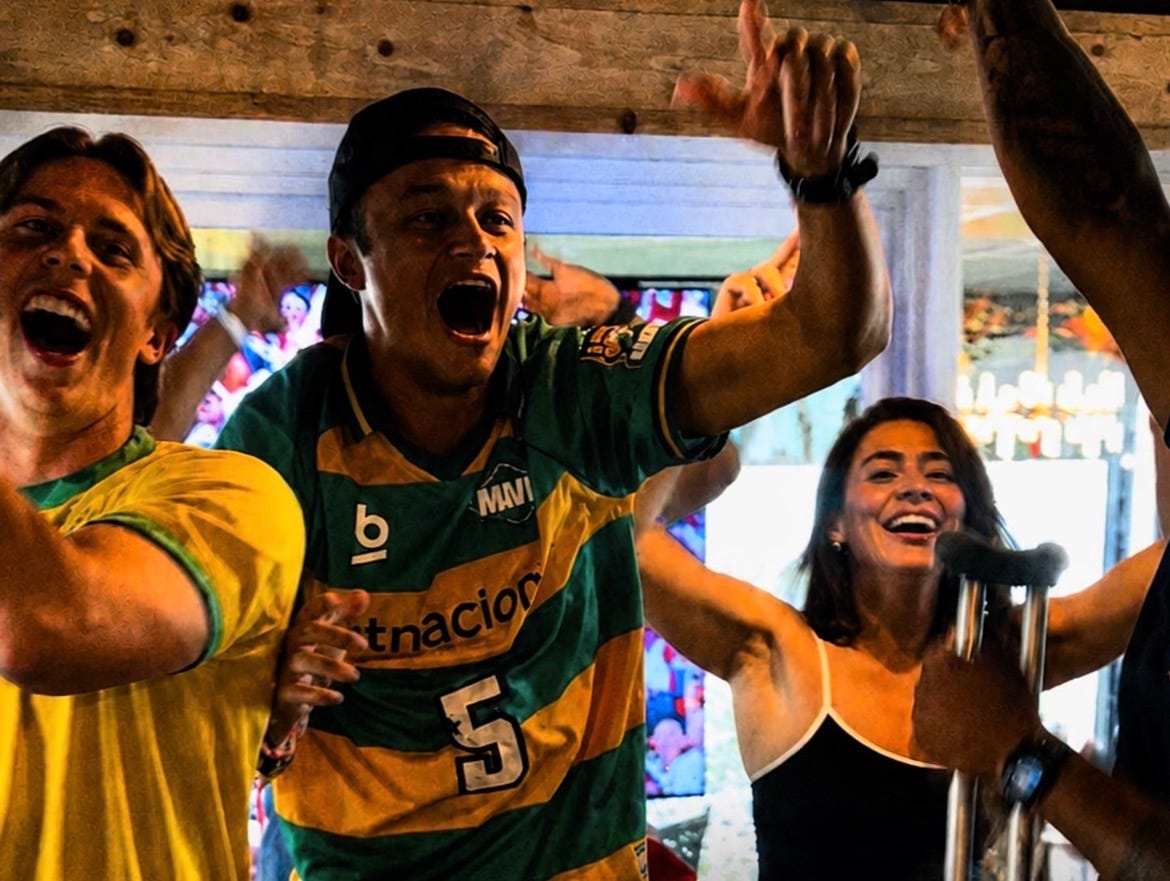
I was right. The place was filled with yellow jerseys, including a rowdy group of young fans situated next to a large television, and some families filling out the calmer area in the back. On the television, Germany and Paraguay were heading to penalty kicks. And it was immediately clear which side the Brazilians were rooting for — they sang songs and erupted into cheers every time Paraguay scored or Germany missed, the families in the back joining voices with the rowdies.
There’s a long tradition of South American teams rooting for each other at the World Cup (though, depending on whom you ask, Argentina might be excluded from that list). South American fans also tend to root against European sides — they’ll almost always back an African or Asian team over any team from Western Europe. It’s not hard to guess why.
And then it occurred to me — this especially boisterous cheering for Paraguay is also about something else. Fans are rooting especially hard because Paraguay is playing Germany — the team that inflicted a trauma on their collective psyche in 2014. The team that embarrassed them on their own soil in the semifinal of the World Cup, on the largest stage imaginable. It was an existential blow to a country with a massive (though not unjustified) soccer ego.
Many of the Brazilian fans at the churrasqueria were too young to remember their side winning the World Cup in 2002. They grew up idolizing Neymar, who has struggled to win major trophies — not Ronaldo, Ronaldinho and Romario, who brought their adoring nation the world’s greatest soccer prize twice in an eight-year span. But everyone there remembered that devastating defeat by Germany in 2014.
That’s why the songs burst forth with a little extra zeal. It’s why the fists were pumped with a little extra fervor. And it’s why one man seemed to be not just psychologically, but physically healed, his crutches thrust in the air as he leapt up and down and clenched the men around him — not for support, but in shared delirium.